Dead-end pole vs. tangent pole: reading structure type off aerial imagery
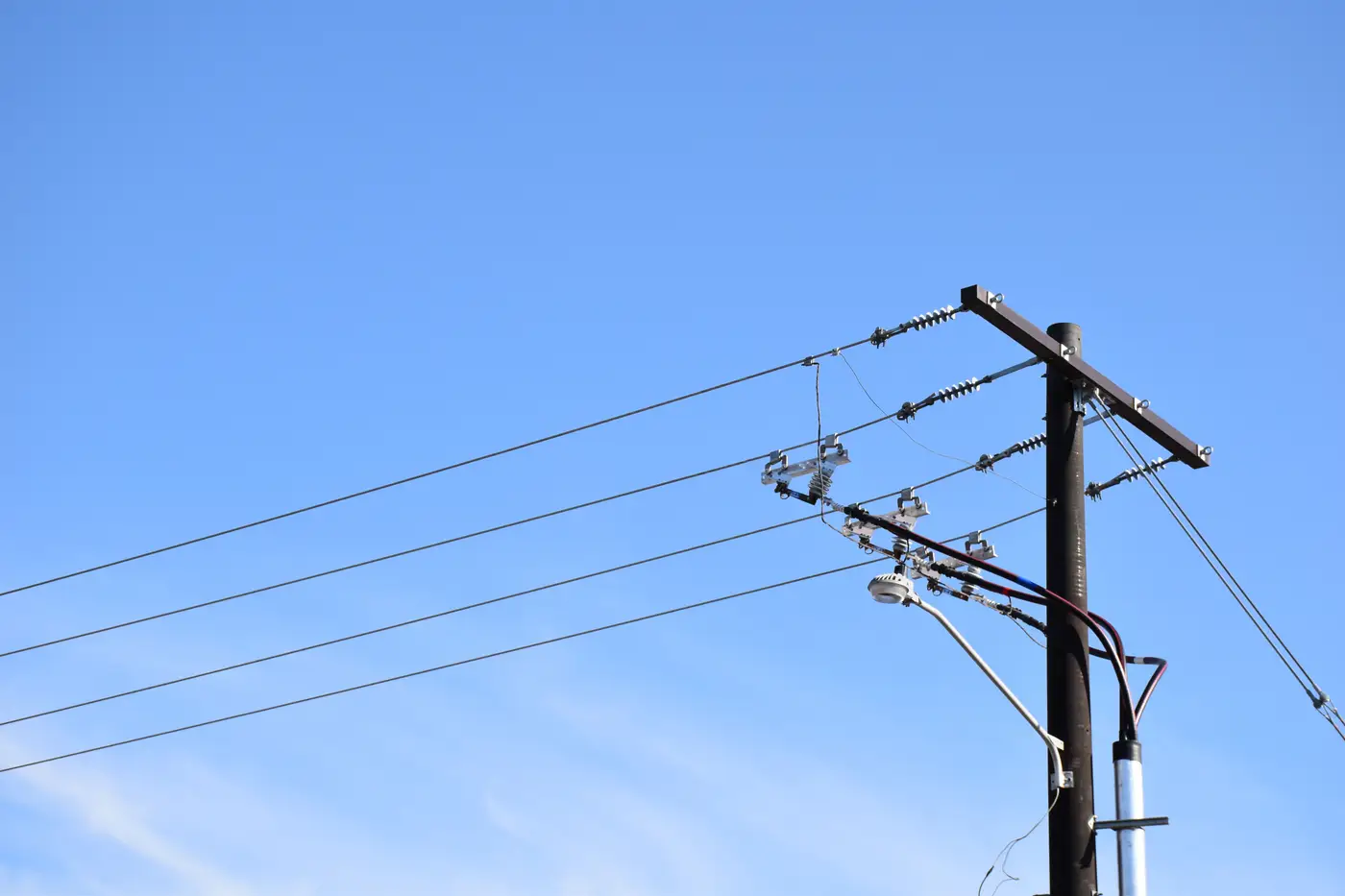
A pole's structure type sits in a dropdown field in most GIS asset registers: tangent, dead-end, angle, corner. Nobody re-checks it after the original build crew logged it, so it sits there until a storm, a line rebuild, or a routine reconciliation turns up a pole that's doing something the register says it shouldn't.
Here's what to look for when you're working off orthophotos or oblique drone capture instead of a bucket truck.
What actually separates the two in the field
A tangent structure carries the line straight through. The conductor comes in on one side and leaves on the other at roughly the same angle, held in place by pin or post insulators on top of the crossarm. The pole takes almost no net pull from the line in either direction, so it doesn't need guying to stay upright.
A dead-end structure is where the line stops, terminates into equipment, or changes direction enough that the pole has to resist a real pull instead of just carrying weight. That means strain insulators (the ones that hang in line with the conductor rather than standing up from the arm), and it usually means a down guy and anchor running out from the base at an angle, sometimes two or three if the pole dead-ends in multiple directions.
What shows up in sub-10cm imagery
Insulator type itself rarely resolves at sub-10cm ground sample distance. Structure type comes through instead as shadow and silhouette, the same cues a line crew picks up from the truck window before they even look up.
The giveaways that do show up:
Guy wires. A down guy throws a long straight shadow or shows as a thin line running from the pole base out to an anchor point, often 15 to 30 feet away depending on pole height and soil. Tangent poles on tangent line don't have these. If you see one guy, you're probably looking at a dead-end or a heavy angle. If you see two or three radiating in different directions, that's almost certainly a dead-end at a line junction or a corner where the pull goes multiple ways.
Conductor geometry. This is the most reliable cue and the one that's easiest to check without ground truth. Trace the conductor path through the imagery on either side of the pole. If it runs straight through at a constant bearing, that's tangent. If it bends more than a few degrees, stops at the pole, or splits into multiple runs, that's a dead-end or angle structure regardless of what the register says.
Crossarm orientation and count. Dead-end structures, especially at substations, taps, or three-phase terminations, often carry more hardware on the pole: double crossarms, transformer banks, riser conduit running down the pole to underground. A pole doing more work tends to look busier in the imagery than a plain tangent carrying three conductors in a line.
None of these is a certainty on its own. A guy wire can also brace a tangent pole against a sharp grade or wind loading on a ridge line with no change in line direction at all. That's exactly why this is a reconciliation problem and not a one-look call: you're comparing what the imagery shows against what the register claims, and flagging the mismatches for someone to check rather than trying to relabel every pole from a photo.
Why this attribute drifts
Structure type gets set once, at construction or at the last major rebuild, and then it just sits in the register. Crews doing storm repair or capacity upgrades convert a tangent to a dead-end, or add a second dead-end direction at a tap point, and the field notes don't always make it back into the GIS edit. A few years of that across a few thousand poles and the register's structure-type field stops matching what's standing in the right-of-way. It matters more than it sounds. Structure type feeds loading calculations, inspection priority, and storm-hardening budgets, so a wrong tangent/dead-end call downstream of the register can throw off work that has nothing to do with mapping at all.
That's the gap Grid Asset Inventory is built to close: it works from the same sub-10cm imagery your reconciliation already runs on and flags the poles whose imagery read doesn't match their register attributes, dead-end and tangent included, so a desk audit catches the drift before a field crew does. If a stack of these mismatches has been sitting unresolved, that's a reasonable place to start.