Single-pole vs H-frame: telling structure types apart in aerial imagery
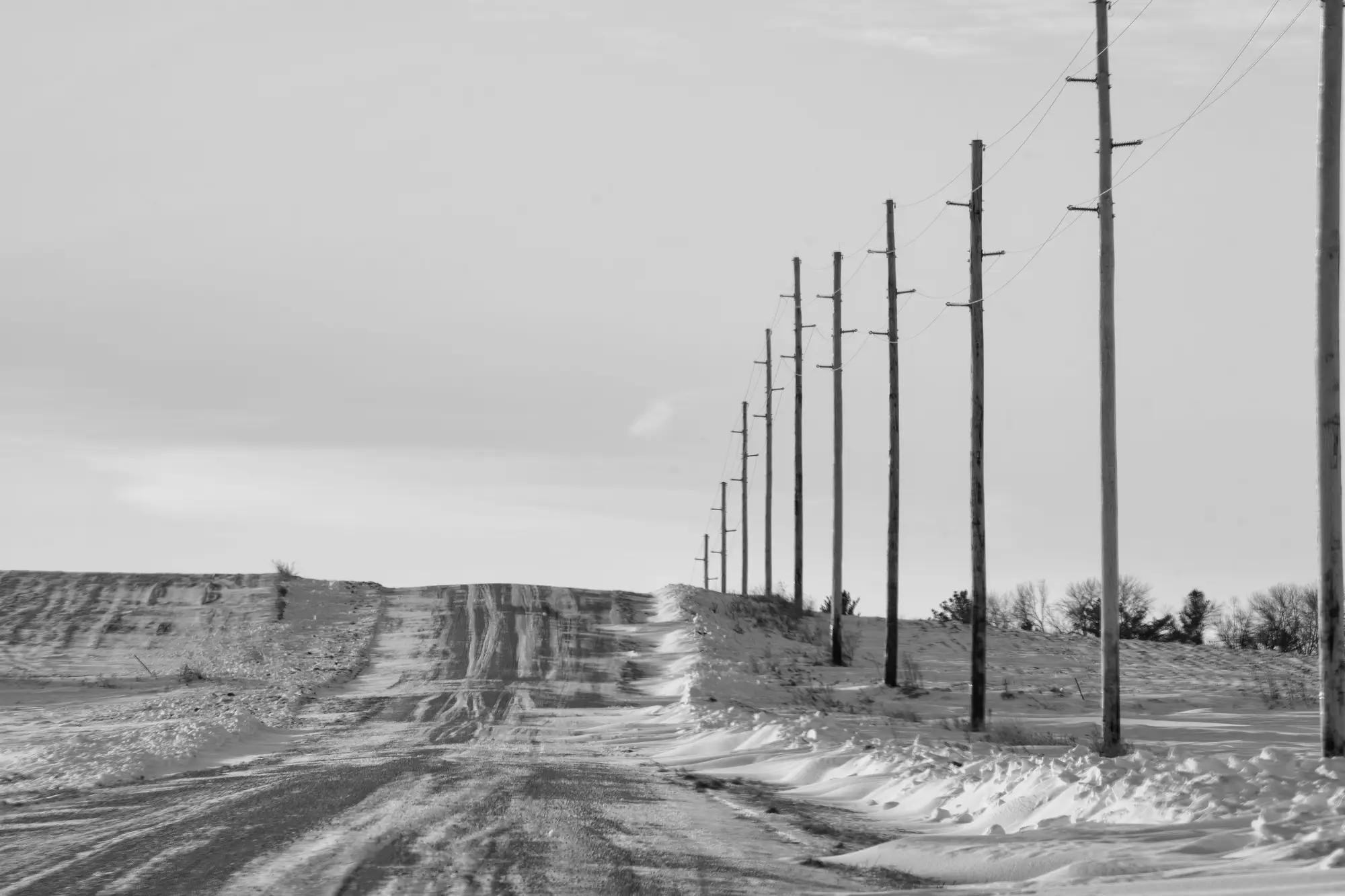
A single-pole structure and an H-frame look nothing alike standing next to a line. From 500 feet up at 7cm GSD, on a gray winter ortho, they can start to blur into each other if you're scanning fast. That's a problem when the structure type field in your GIS is what drives loading calculations, clearance checks, and which crews you dispatch for a rebuild.
Most registers were populated years ago from as-built drawings or a one-time field walk. Structures get swapped during storm rebuilds, capacity upgrades, or right-of-way settlements, and the database doesn't always catch up. The visual tells below are the same ones a field inspector uses, just applied to imagery instead of a bucket truck.
Reading a single-pole structure from above
A single-pole is exactly what it sounds like: one vertical member carrying the conductors, usually with a crossarm or davit arms bolted near the top. In nadir (straight-down) imagery, you're looking for one circular or slightly oval shadow footprint at the base, with conductors radiating from a single point. The crossarm, if there is one, reads as a short perpendicular line through that point, rarely more than 8-10 feet across in the image.
Oblique or slightly off-nadir frames help more than straight-down shots here, because they show the pole's shadow stretching out as a single unbroken line. If guy wires are present, they'll fan out from that same single base point, which is another giveaway you're not looking at a frame structure.
Single-pole is the default assumption for most distribution lines, and for a lot of subtransmission too, so the real work is catching the exceptions.
Reading an H-frame structure from above
An H-frame carries the line on two separate poles set a fixed distance apart, tied together by a horizontal crossarm or brace that gives the structure its name and its lateral strength. From above, this shows up as two distinct shadow footprints, not one, spaced anywhere from roughly 10 to 20 feet apart depending on voltage class and the standard your utility builds to. The crossarm between them is long enough to read clearly in sub-10cm imagery, often as a solid horizontal bar connecting the two shadows.
The other tell is symmetry. Conductors leave an H-frame from two separate attachment points rather than converging on one pole, so if you trace the conductor paths back and they split into a pair rather than a single bundle, you're looking at a frame structure even if the pole spacing is hard to judge from the shadow alone.
Transmission lines and some three-phase subtransmission runs lean toward H-frame construction more than distribution does, so structure type often correlates with voltage class and corridor, which is useful context when you're triaging a long run of imagery rather than confirming it in isolation.
Where the register and the imagery disagree
The mismatches that show up most often in a reconciliation pass aren't exotic. A storm rebuild replaces a single-pole with a temporary H-frame to get the line back up fast, and the temporary structure becomes permanent while the database still says single-pole. A capacity upgrade converts a run of single poles to H-frames for the added strength, and the as-built never makes it back to the GIS team. Or a structure gets tagged correctly at install and then someone fat-fingers the attribute during a bulk data migration five years later.
None of these show up by querying the database against itself. They show up when someone, or something, looks at the current imagery and counts what's actually standing in the right-of-way, structure by structure, against what the register claims is there.
That comparison, done by eye across a few thousand structures, is the kind of audit that eats a field crew's whole season. Grid Asset Inventory runs that detection pass against your latest flight and hands back a list of poles, towers, and conductors as the imagery shows them, so you're reconciling your register against what's standing in the corridor rather than trusting it by default.
If a structure-type mismatch like this is sitting in your register right now, it's worth seeing what your next flight would turn up.